Background
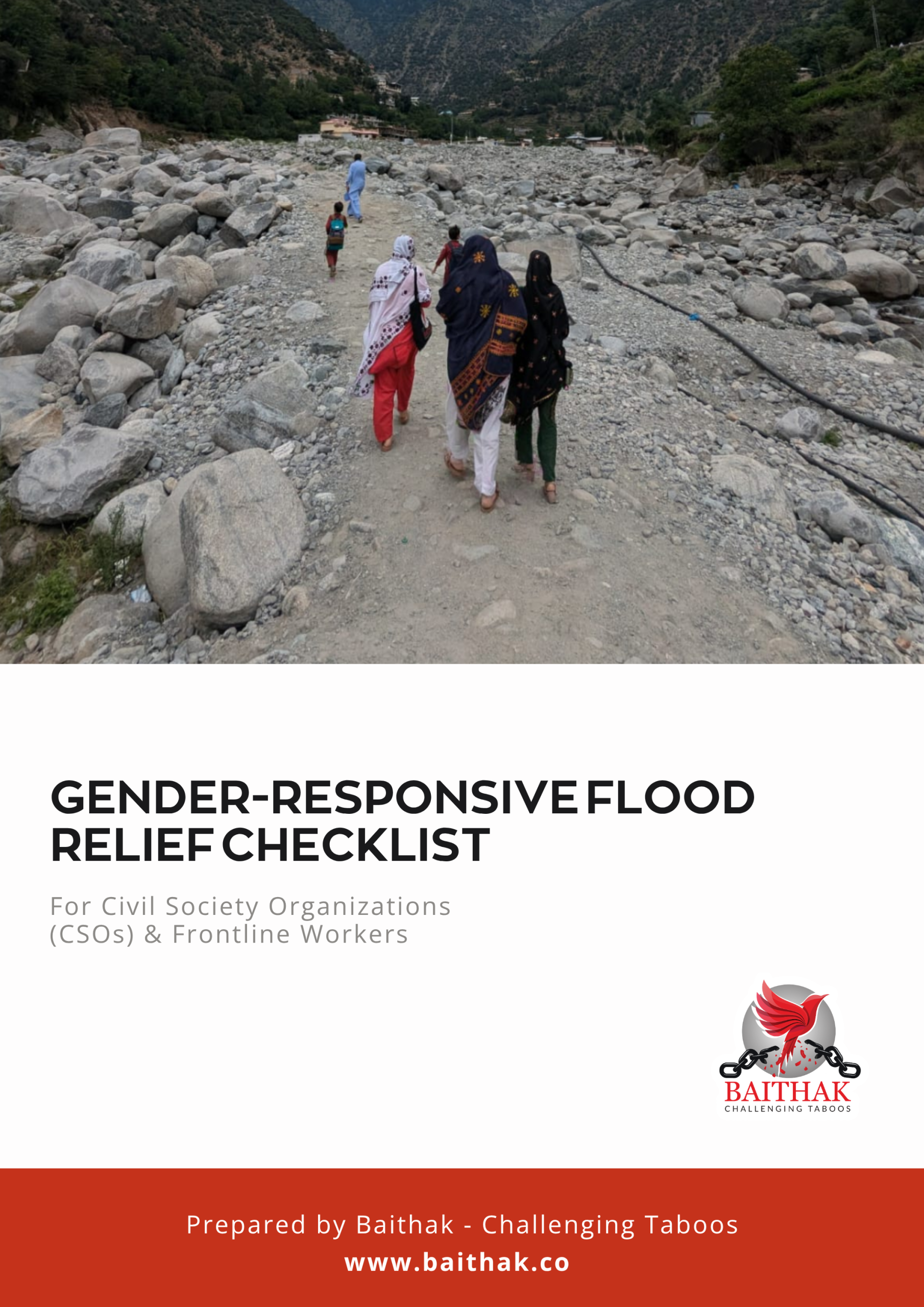
This Gender-Responsive Flood Relief Checklist has been developed as a practical tool for civil society organizations (CSOs) and frontline workers responding to the ongoing floods in Pakistan. It highlights the immediate, short-term, and medium-term needs of women, adolescent girls, elderly women, women with disabilities, transgender persons, and women-headed households in disaster contexts.
This checklist builds on our ongoing work with the climate crisis–affected communities in Pakistan. It draws from our multiple study drives, including research that we conducted in climate-affected regions of Khyber Pakhtunkhwa (KP) in 2024, and is further informed by our extensive consultations with grassroots CSOs, adolescent girls, women, and transgender persons in the aftermath of the devastating 2022 floods.
By combining these local insights with global humanitarian guidelines (IASC, Sphere Standards, UNFPA MISP), this resource reflects not only international best practices but also the realities, voices, and lived experiences of those on the frontlines of climate disasters in Pakistan.
Who is this for?
This toolkit is designed for:
- CSOs, community volunteers, and grassroots organizations working directly in flood-affected areas.
- Relief workers and frontline responders who need a quick, actionable guide to ensure that the specific needs of women and gender minorities are not overlooked.
- Local authorities and humanitarian partners who want to strengthen their relief efforts through a gender-responsive lens.
How to use this checklist
This checklist is organized by specific groups of women and gender minorities who face distinct risks and needs during floods in Pakistan. Each section highlights immediate (first 48–72 hours), short-term (1–2 weeks), and medium-term (1–2 months) actions that CSOs, volunteers, and relief workers can take. The guidance is meant to be practical and field-ready, helping frontline responders ensure that no group is left behind.
Checklist of Gender-Responsive Needs in Flood Relief
Pregnant women
- Immediate Response (first 48-72 hours)
- Ensure pregnant women are visibly identified and prioritized during evacuation.
- Assign separate, safe and private shelters/spaces for pregnant women (avoid overcrowding).
- Confirm availability of clean drinking water and high-energy snacks for them during relocation.
- Provide delivery kits with: clean razor blade, cord ties, gloves, soap, clean plastic sheet, and baby blanket (to be used by trained birth attendants, lady health workers or community midwives).
- Coordinate with local health staff to identify high-risk pregnancies requiring urgent attention.
- Short-term response (1-2 weeks)
- Facilitate mobile or on-site antenatal care services (blood pressure check, and iron supplements).
- Ensure access to clean private washrooms with water and soap.
- Provide information and helpline numbers for nearby health facilities and ambulance services (in local language).
- Include psychosocial support/counselling in coordination with health staff where possible.
- Provide maternity kits (soap, sanitary napkins, undergarments, new-born blanket, towel, etc.).
- Medium-term needs (up to 1-2 months)
- Facilitate antenatal and postnatal care through mobile clinics or by linking with local health staff.
- Ensure referral pathways are functional for safe delivery at health facilities or with skilled birth attendants.
- Establish a post-delivery follow-up system to monitor the health of both mother and newborn.
- Provide information and discreet access to family planning and birth spacing services in camps or temporary settlements.
Young/Adolescent Girls
- Immediate response (first 48-72 hours)
- Ensure safe evacuation and registration of adolescent girls with their families or trusted female guardians.
- Provide menstrual kits, (including pads; both cloth and disposable options, pair of underwear, a bar of soap and small packet of washing powder, and small torch/solar lamp if possible
- Set up private washing/changing areas clearly marked along with solar lamps/small torches to avoid risk of GBV.
- Disseminate information on safe/unsafe areas within camps in languages understood by adolescent girls.
- Short-term response (1-2 weeks)
- Conduct brief orientation sessions with adolescent girls on available services (hygiene, GBV helplines, health points, etc.)
- Collaborate with to monitor and report cases of harassment or exploitation.
- Facilitate informal learning or recreational activities in safe spaces to reduce trauma and isolation.
- Medium-term needs (up to 1-2 months)
- Establish adolescent-friendly health corners that offer counselling and SRH information.
- Initiate peer-support circles or safe clubs led by trained female facilitators to build solidarity and awareness.
- Ensure consistent supply of menstrual health materials and safe disposal mechanisms in camps. Incorporate life skills and GBV prevention messages into ongoing outreach with adolescent girls.
- Create clear referral pathways for adolescent GBV survivors to health, legal and psychosocial services.
Elderly women
- Immediate response (first 48-72 hours)
- Prioritise elderly women during evacuation and registration.
- Provide easy-access shelter areas.
- Ensure availability of basic medicines and mobility aids.
- Assign female staff to assist with personal care, if needed and possible.
- Short-term response (1-2 weeks)
- Facilitate regular basic health checks (BP, glucose).
- Ensure access to washrooms close to shelter.
- Offer information on available health services in simple language.
- Medium term needs (up to 1-2 months)
- Arrange continued access to chronic illness medication.
- Provide psychosocial support or regular check-ins to reduce isolation.
- Integrate them in community support networks and activities.
Women with disabilities
- Immediate response (first 48-72 hours)
- Prioritise safe evacuation and registration with required assistance.
- Ensure shelter access routes are accessible.
- Provide immediate access to assistive devices (wheelchairs, canes, hearing aids, etc.) ○ Assign support staff to help with mobility and communication needs.
- Short-term response (1-2 weeks)
- Ensure health services are disability-friendly.
- Communicate key information in multiple formats (visual, audio, simple text). ○ Monitor for heightened risk of exploitation and report immediately.
- Medium term needs (up to 1-2 months)
- Ensure continued supply and repair of assistive devices.
- Include women with disabilities in feedback and decision-making processes. ○ Provide psychosocial support tailored to disability-related needs.
Transgender Persons
- Immediate response (48-72 hours)
Ensure respectful, self-identified registration without misgendering.
Provide safe shelter spaces – separate from male/female if needed.
Ensure access to basic hygiene kits.
- Short-term response (1-2 weeks)
- Provide access to health services without stigma or judgement.
- Share info about complaint mechanisms and protection services.
- Monitor shelter for signs of exclusion or GBV risks.
- Involve trans-led groups where possible for outreach and trust-building.
- Medium term needs (up to 1-2 months)
- Enable safe access to mental health and psychosocial support.
- Respect and protect privacy in all documentation and service delivery.
- Include trans voices in crisis response feedback.
Creating Safe and Dignified Spaces
- Assign female volunteers to conduct regular safety checks, particularly for adolescent girls and unaccompanied women.
- Create safe spaces within shelters for women and girls (recreation, psychosocial support, peer circles).
- Ensure gender-segregated washrooms with clean water and soap, located close to shelters. ○ If gender-segregated facilities are not possible, create timed or guarded access with female volunteers present.
- Provide private washing/changing areas with adequate lighting and secure locks.
References: