

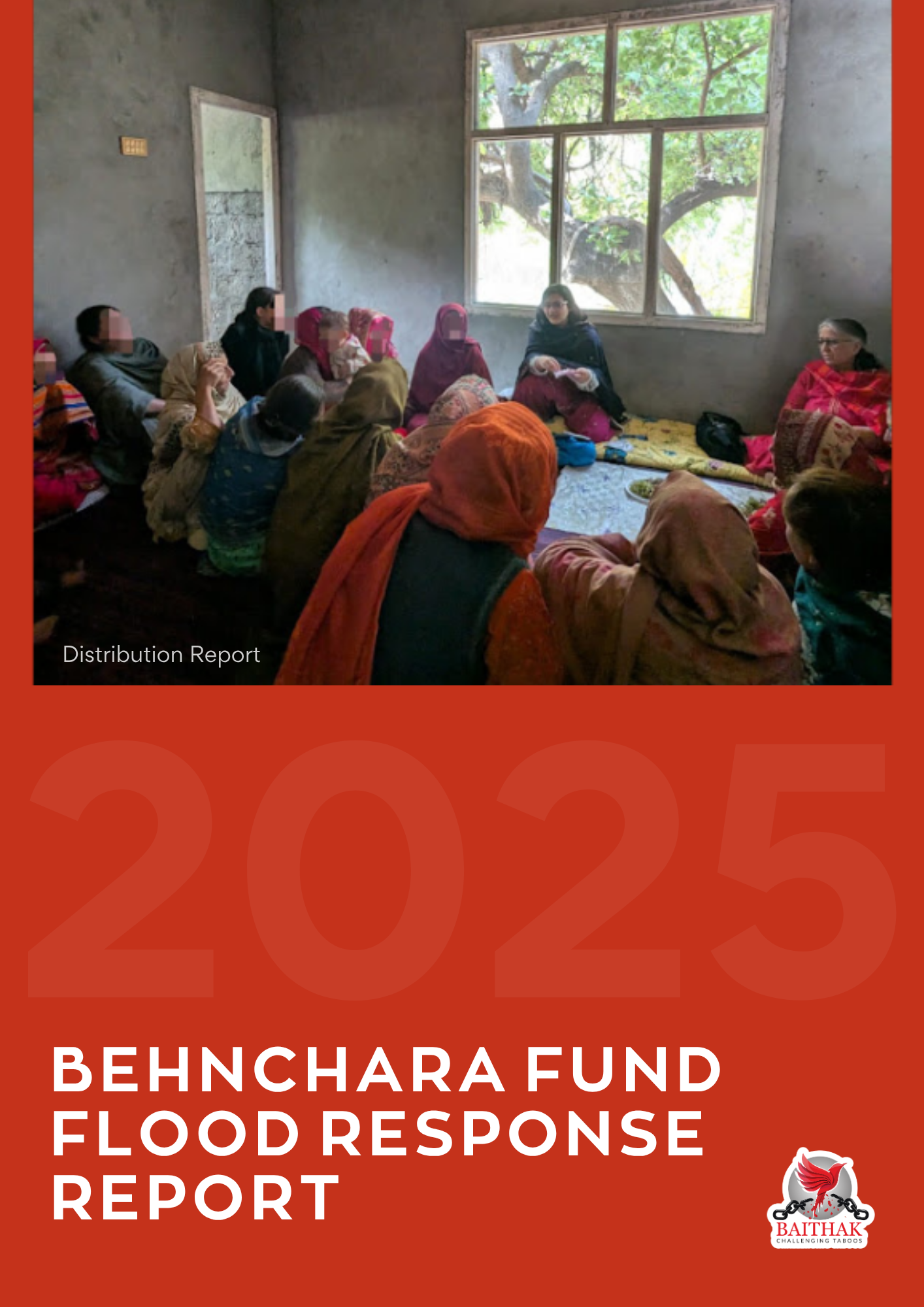
In August 2025, as floods devastated several regions of Gilgit-Baltistan (GB) and Khyber Pakhtunkhwa (KP), Baithak – Challenging Taboos launched the BehnChara Fund, an emergency fundraising campaign to provide menstrual health and safe delivery kits to women and girls in the most affected areas.
The initiative aimed to address the immediate health and dignity needs of women who often remain invisible in disaster response plans. With the support of our community of donors, allies, and volunteers, the BehnChara Fund enabled the distribution of essential supplies to ensure that women’s menstrual and maternal health needs were not overlooked during the crisis.
The flood response was designed and is being implemented in three phases:
Rather than relying on a single standardized assessment, Baithak adopted a context-responsive approach, allowing local partners to flag urgent needs based on their proximity to and trust within communities.
The distribution process followed a decentralized, partner-led model, designed to adapt to varying ground realities across regions:
Alongside the distributions, four medical camps were organized: two in Swat, reaching around 150 women patients, and two in Buner; one at Bishnoi serving 200+ patients, and one at Gokand serving approximately 150 women patients.
Based on consolidated records from our flood response efforts approximately 11,000 menstrual health kits and 500 safe delivery kits were distributed across the targeted regions
Download PDF

Copyright © 2026. All Rights Reserved By Baithak - Challenging Taboos - Powered by Boostix Digital